
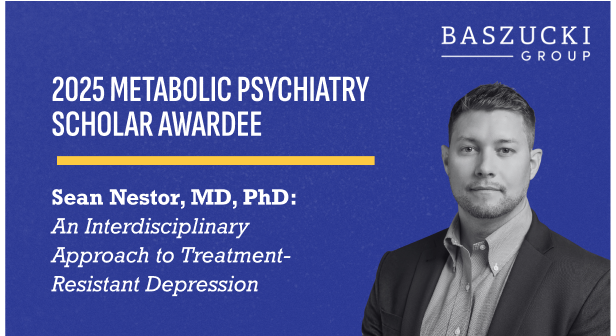
Dr. Sean Nestor has built his career on developing new ways to push research forward. As an
MD-PhD candidate, he developed a novel method to rapidly and accurately segment brain
anatomy from MRI scans. Now, a clinician investigator and interventional psychiatrist at
Sunnybrook Research Institute in Ontario, Canada, he combines brain imaging and
investigational neuromodulation techniques (specifically transcranial magnetic stimulation, or
TMS) to improve outcomes for people living with difficult to treat depression. These techniques
are effective but expensive, making them inaccessible to many patients.
It was this unrestricted, interdisciplinary mindset that led him to metabolic psychiatry. Nestor had
been conducting neuromodulation clinical trials in patients with treatment-resistant depression
when he noticed a strong correlation between patients who–despite receiving very advanced
sequences of brain stimulation–were not seeing improvements in their mental state, and those
who had metabolic disorders. This observation led Nestor and his team to investigate the link
between metabolic health and a response to brain stimulation. “We began to take blood markers
from these patients and look at relationships, for example, between glucose measures and their
clinical response to brain stimulation like transcranial magnetic stimulation. And we began to
see some early results. This led my group to think about ways that we could potentially use this
information to enhance the treatment,” says Nestor.
Nestor’s initial trial results were compelling, suggesting that dietary changes could enhance
treatment. “If we can potentially modify metabolism through something as simple as a dietary
change, we may be able to improve the way the brain responds to brain stimulation and
remodels itself.” Nestor explained. “This may lead to sustained treatment outcomes for patients
who have not previously responded to conventional therapies in depression.”
For Nestor’s team, enhancing and improving treatment outcomes for patients is critical. To
qualify for his ongoing treatment resistant trials, patients must have severe symptoms and have
been unable to find relief with pharmacological treatment options. The field has typically focused
on using expensive technology and devices to improve treatment outcomes. But, too often,
innovations do not equate to better patient wellbeing. Nestor’s project takes a different
approach: instead of developing expensive machinery, they investigate whether we can pair
widely deployed technologies, like brain stimulation, with simple interventions, like diet, to
improve outcomes.
At this stage in his career, Nestor is clear that building a strong team is at the core of his
approach to science. “Success comes from a team and not just an individual,” he explains. “In
many ways, a lab is like a small business and so it’s key to grow things, scale, and have the
right personnel assembled to be able to conduct research at a larger scale.” For those starting
their labs he offers the following advice: “Start thinking about ways you’re going to build your lab
in terms of key personnel and hires and the rest will take care of itself.”
The Metabolic Psychiatry Scholar Award is the first piece of major funding that Nestor’s lab has
received to conduct metabolic psychiatry research and move this work forward. The award will
be pivotal in terms of launching a platform for conducting metabolic psychiatry research in the
field of brain stimulation, allowing him to hire and provide more opportunities to trainees and
foster multidisciplinary scientists both within his lab and beyond. In addition to furthering his
work, Nestor is excited for the community of like-minded researchers he will meet as part of the
2025 Metabolic Psychiatry Scholar Award cohort. “I’ve always appreciated large-scale
communities in the field of science, spanning projects or groups,” says Nestor, “These
communities bring experts together to creatively address problems and think of new ways of
approaching ideas that you cannot do as an individual or in a siloed approach.”