
Nearly a decade ago Dr. Erin Bellamy began questioning the limits of the current standard of care for inpatient psychiatric treatment. “I was working in an inpatient psychiatric unit and could see that my patients weren’t receiving lasting relief,” she says. Around the same time, new research on low-carbohydrate diets for Type 2 diabetes was making headlines, with some studies pointing to unexpected improvements in mood. These findings led Bellamy to dive into the literature on metabolic connections to psychiatry, where she found a small 1965 study that tested ketogenic diets as treatment for schizophrenia. To her surprise, the trial had never been pursued further. “I thought there had to be something there that warranted a closer look,” said Bellamy. “All I wanted to do was help people improve their mood and symptoms, and live a happy life.”
What started as a follow-up on a side-effect from an interesting paper became the basis for Bellamy’s research career. In graduate school, she pursued her PhD part-time while continuing a full-time career in the National Health Service and working with private companies in the metabolic health space. In anticipation of the need for scalable, at-home support, her project focused on ketogenic diet and depression in a remote care model. “I wanted people to be able to implement this safely and effectively from the comfort of their home,” she says, “because I knew that would help those who were geographically isolated or too unwell to attend in-person care.”
This commitment to scale and accessibility has remained the underpinning of her work today, both in research and through her clinical practice, Integrative Ketogenic Research and Therapies (IKRT). The research is challenging at times; recruitment for her trials has been difficult, and adherence can be a challenge among participants struggling with severe psychiatric conditions. “There’s no point in showing the benefits of a ketogenic diet if we don’t have a way to reach people globally,” she explains. “The impact of mental health conditions on society is astronomical. We need therapies that can scale.”
Looking back on her own journey, she offers a simple but powerful piece of advice for early-career researchers: keep going. Having received skepticism in her own career, particularly in the early days of working with ketones and mental health, she knows the value of perseverance. “If you’re obsessed with something, stay committed to the cause. Ask a lot of questions and don’t take no for an answer. I wouldn’t be here without asking questions, remaining curious, and being absolutely steadfast in the pursuit of what I wanted to do.”
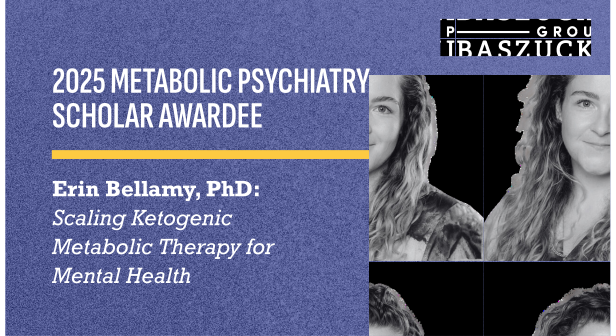
For Bellamy, receiving the Metabolic Psychiatry Scholar Award is both a turning point and a validation. After years of slow progress, constrained by time and limited resources, she believes that the award will catapult her career forward. “This award is going to push this research at a rate that absolutely was not possible until now,” says Bellamy “I know the road ahead will be bumpy, but I have no doubt we will get there.” She plans to expand her team at the University of East London, recruit more participants, and integrate quantitative and qualitative approaches—all while continuing to run her clinical practice, something that wasn’t previously feasible. What excites her most, though, is the opportunity to collaborate across disciplines and countries and increase cross-researcher communication. “Research too often sits behind paywalls. People take conclusions out of context. I want the findings to be accessible—to reach the right people in the right places, in language they understand.”