
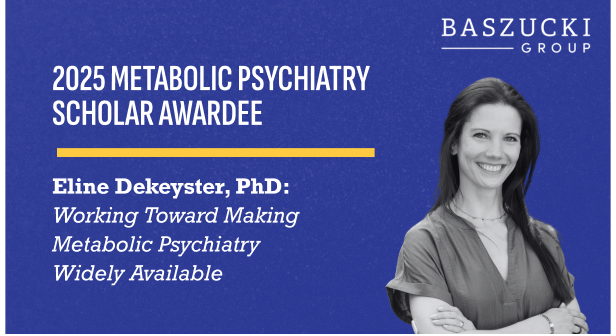
Dr. Eline Dekeyster’s connection with metabolic psychiatry is personal. While working in the
pharmaceutical industry, she began searching for a treatment for her own gastrointestinal issues
and was recommended a ketogenic diet. The results were transformative. Not only did her GI
symptoms resolve but she recalls “feeling clarity in my mind, and my mood improved and
became more stable.” Her interest piqued, she dove into the literature.
Soon after, she launched a company dedicated to public education and coaching for those who
wanted to adopt a ketogenic diet or take exogenous ketones. When she had a chance to move
her work into an academic setting, she was able to harness her expertise to start her own
research program.
Dekeyster’s research group, the Lifestyle Brain Interaction (LBI) lab, studies the intersection
between our lifestyle and the brain in health and disease across lifespan. They take a
transdiagnostic view in their practice of metabolic psychiatry, which is based on the concept that
unregulated metabolic health underpins multiple different diagnoses. Their focus for this
particular project: people with autism spectrum disorder. “Autism spectrum disorder, especially
in adults, is an underrepresented population in research on ketogenic therapy worldwide,” she
says. Dekeyster and her team now plan to carry out a larger-scale study in adults with autism
spectrum disorder to test whether ketogenic metabolic therapy, in combination with support, is
an effective treatment.
One of the big challenges in metabolic psychiatry can be diet compliance. The LBI lab is
developing strategies to make long term adherence more sustainable, ranging from tools that
gamify the diet, rewarding people for sticking to it, or educational tools that help patients
understand the diet and its benefits. They also offer companion training, so that people feel less
alone in their efforts, and personalized approaches that take into account individual food
preferences.
As research methods have advanced, Dekeyster’s research has evolved with them. “As a
Neurobiologist, I used to focus on pure biomedical readouts, like blood markers and brain
scans.” says Dekeyster. “But now quality of life is the primary readout in my research, because
that is the most important thing to the patient.” Her lab uses a combination of tailored,
personalized strategies, wearable sensors, and cutting-edge tools like electroencephalography
(EEG) in their patient support.
Dekeyster believes that metabolic psychiatry should be available to all patients. She works with
government institutions and insurance agencies to embed ketogenic metabolic therapy into
guidelines for people with mental health issues. “When the scientific evidence grows, over time,
it can also be embedded as standard of care treatment,” says Dekeyster, “For now, we are
carefully exploring its potential in selected patients under close medical supervision.” In the
future, Dekeyster hopes that the knowledge that her research group and others gain can be
shared internationally, tailoring programs to the local culture.
Her advice to early career researchers? “Follow your intuition.” She follows her gut when it
comes to finding research directions and collaborations, and advises others to do the same.
“This way of working keeps you authentic, gives you more fulfillment and attracts collaborators
who share your mission and vision,” she says. “That way, you can really make an impact on the
world.”
Dekeyster is excited about the collaborative opportunities that the Metabolic Psychiatry Scholar
Award will bring. “I think the global network that we are developing is very strong, especially
because it isn’t based on competition.” She is looking forward to getting feedback from others in
the community on her protocols, contributing toward building the field of metabolic psychiatry
and collaborating on ways to bring ketogenic therapy into the clinic and medical curricula. “This
award will give my career an exponential start and help me grow my research group,” she
shares.