
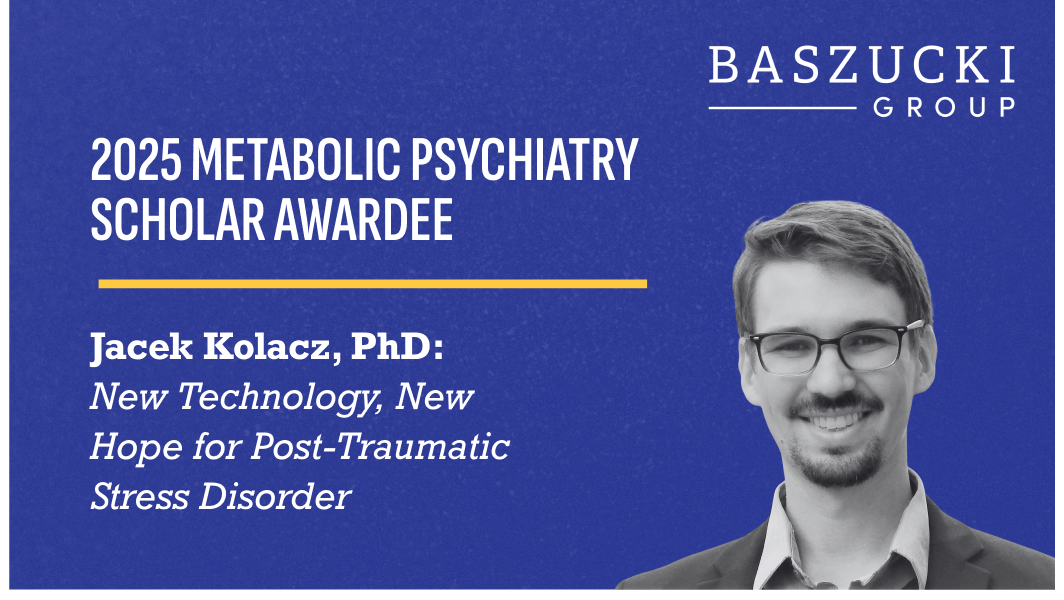
For Dr. Jacek Kolacz, mental health treatments are about addressing underlying causes, not
just symptoms. His work focuses on patients who have lived through chronic threat, including
those who have developed post-traumatic stress disorder (PTSD). These patients often have
complex disorders of both the brain and body, including the heart, gut, and even vocal muscles.
To understand why, Kolacz realized he needed to go beyond talk therapy and study the body’s
physiology–and that meant collecting more data.
Unfortunately, many clinics are not well set-up for data collection during therapy, so Kolacz
struggled to find clinical collaborators. But, when he joined The Ohio State University, he knew
he had found the right place to build his laboratory. “I work with therapists who are curious and
open minded about the measures that I’m bringing into therapy sessions, and what they can tell
us about treatment,” he says.
Kolacz first discovered metabolic psychiatry when he was investigating why patients who
experience hyperarousal symptoms related to PTSD are often non-responsive to frontline
psychotherapy. These patients often have problems with their mood and sleep that are not
resolved by cognitive processing psychotherapy. At the time, there was no research into
whether a ketogenic diet could be effective for PTSD, even though it had shown so much
promise in other areas. “It seemed like a good opportunity to take a metabolic psychiatry
approach and pair it with a frontline treatment like cognitive processing therapy to see if we do
better for those types of hyperarousal symptoms. And if a metabolic approach is effective, can
we understand why?”
Kolacz hopes his research will lay the groundwork for a randomized controlled trial (RCT)
examining the long-term effects of pairing a metabolic psychiatry approach with psychotherapy.
He also aims to shed light on the mechanisms by which a metabolic psychiatry approach
influences arousal. “My dream is a randomized controlled trial,” he says “But to get there, we
need pilot data to show feasibility. We also need data that can help us figure out the study
design choices that can capture the benefits we’re hoping to see.”
Kolacz’s work makes use of wearable sensors, a technique that has “exploded” in recent years.
His work uses these sensors to capture participants’ daily activities, giving a 360-degree view of
their physiological arousal.
Kolacz’s team science mindset is prominent in his own lab. To accomplish his ambitious goals
he draws on the individual strengths of each lab member to support their creativity and
independence. “I try to foster resilience by helping my team understand working with people in
PTSD recovery is emotional. I check in with my team, make sure they’re doing okay, and then
give them support or space to take some time away if they need it, to process what’s been
happening and to avoid burnout.”
If Kolacz could give one piece of advice to early career researchers, he would advise them to
stay in touch with their curiosity and passion. “What’s been important for me has been making
sure that I stay connected to what is most rewarding about this work,” he says. “So that I can
keep myself going through times that can be sometimes challenging when you work as a
researcher.”
Kolacz sees the Metabolic Psychiatry Scholar Award as a chance to be part of the broader
metabolic psychiatry community. “Science is a group effort,” says Kolacz. “I was very excited to
see the diversity of perspectives that are represented within the cohort. Hopefully, by getting
together we can advance science more quickly than we could if we were working in our
standard, more siloed mode.”